 Loading...
Initial language selection is based on your web browser preferences.

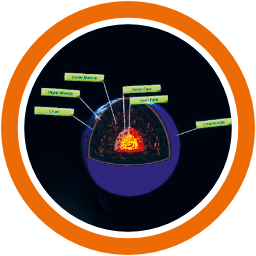

# Age Range The primary target age range for this experience is ages 9 to 11; however, the model is easily adaptable for the 11 to 14 age group (see *Framework Adaptations*). # Curriculum Summary* ## Science: Earth and Space – Ages 9 to 11 Students should be taught to: - Recognize the sun, Earth, and moon as spherical bodies within the solar system. - Use models to explore the structure of planets and moons, including layers beneath their surfaces. - Compare the roles and relationships of the sun, Earth, and moon as part of a wider solar system. # Learning Objectives - Recognize that Earth is a spherical planet in the solar system. - Identify and name the main internal layers of Earth. - Rebuild an explodable model of Earth to show how its layers fit together. # Key Vocabulary - **Atmosphere:** Layers of gases surrounding Earth. - **Crust:** The thin, solid outer layer of Earth. It includes land and the ocean floor. - **Upper mantle:** A thick layer of hot rock. It is solid but can slowly move over time. - **Lower mantle:** Beneath the upper mantle and made of the same type of rock. It is hotter and under more pressure. - **Outer core:** A layer of liquid metal, mostly iron and nickel. Its movement creates Earth’s magnetic field. - **Inner core:** A solid ball of metal in the very center of Earth. It is made mostly of iron and nickel and is the hottest part of the planet. # Equipment - **VR headsets:** Enough for the planned groups (minimum four recommended; ideally one per student). Ensure the Earth Xplodable is loaded and ready for use. - **Whiteboards or books (optional):** For note-taking, drawing, labeling, or reflection activities. - **Worksheet (optional):** Printout of the Earth for the labeling exercise (see *Extended Learning*). **Note: If a full class set of headsets is unavailable, use the Optional Activities in the During the Experience section to create a class rotation with students taking turns in the VR experience.** **Our Curriculum Summary offers a simplified and progressive best-fit framework derived from a thorough analysis of multiple curricula worldwide, including those from the US, UK, and the rest of the world. By identifying key common strands, we create curriculum statements that align and map smoothly across all territories, ensuring relevance and consistency in diverse educational contexts. Further territory-specific curriculum libraries can be found on the ClassVR portal.* # Teaching Framework{.objective .objective} ## Prior Learning The Teaching Framework assumes students have no embedded prior knowledge of the key vocabulary introduced in the Xplodable. Before beginning, check students understand that: - The sun, Earth, and moon are part of the solar system. - Earth is a planet, and has one natural satellite, the moon. - The Earth moves around the sun and rotates on its axis. - The Earth is roughly spherical in shape. ## Before the Experience Begin the lesson by allowing students to spend five minutes exploring the unlabeled Earth Xplodable by selecting “Explore” on the menu. Students should observe the different parts of the interactive model and think carefully about what these structures might be. Encourage them to consider if they recognize any parts or remember their names. Students can work individually or in small groups and take notes on a whiteboard, allowing them to share their ideas. ## During the Experience Find a suitable diagram of the Earth and using the *Key Vocabulary* describe each individual part using simple, age-appropriate definitions (or use ClassView on the ClassVR portal to show the Xplodable and its labels on the class board). Explain how the different parts of the Earth fit together to make up its whole structure. This opportunity enables students to ask questions and clarify their understanding before proceeding. Optionally, show students a video about the Earth or direct them to a reliable website for further research. Students can make notes on a whiteboard or in their books to support their learning. ## Key Questions What shape is the Earth, and how do we know? {.task} **Example answer:** The Earth is roughly spherical, which has been confirmed by images from space. {.info} How does the Earth move in space? {.task} **Example answer:** The Earth rotates on its axis, while it orbits around the sun. {.info} Can you name the main layers of the Earth and describe what they are made of? {.task} **Example answer:** Answers may include: the crust is a thin, rocky surface, the mantle is a thick layer of solid rock, the core is made mostly of iron and nickel, the outer core is liquid metal, and the inner core is solid metal. {.info} Next, return students to their devices or headsets and ask them to select "Labels On". This allows them to check and reinforce their memory of the names and locations of each part of the Earth as they explore further. Ask students to select "Explode" and the parts will separate and become individual components. Challenge students to drag and drop the exploded parts back into their original positions to rebuild the Xplodable. Discuss any misconceptions, encouraging students to consider how the different layers build up the Earth’s overall structure. Following this, students can take the *Beginner* quiz within the Xplodable, testing their knowledge of the Earth by attempting to label the model correctly again. For an additional challenge, students can take the *Challenge* quiz, where they match each piece of key vocabulary to its correct definition. The quizzes provide opportunities for both formative assessment during learning or summative assessment to evaluate understanding after the lesson. ## Optional Activities These activities can rotate around the classroom to revisit key vocabulary and concepts, helping students strengthen recall through repetition, discussion, and creative application. Students connect terms and definitions in different contexts, which supports long-term memory and deeper understanding. ## Research - Show a video about the Earth or direct students to a reliable website for further research. Students can make notes on a whiteboard or in their books to support their learning. ## Quick-fire: - *Explain It Back*: Students choose a part of the model and describe its function to a partner without saying its name. The partner must identify the correct term. - *Vocabulary Bingo*: Students write down a selection of key terms in their books or on whiteboards. The teacher reads out the definitions in random order, and students cross off the matching word if they have it. The first to complete their list calls “Bingo,” before reviewing the answers together. ## Creative: - *Sketch and Label*: Students draw a quick outline of the model in their books or on mini whiteboards. From memory, they label as many parts as possible, then check against the Xplodable and correct any errors. ## Active learning: - *Vocabulary Exchange*: Each student writes one key term with its definition in their book, on paper, or on a whiteboard. Students then move around the classroom, adding one different term and definition to another student’s page at a time until all terms are collected. ## After the Experience Ask Students to consider how interacting with the Earth in the Xplodable helped them in their learning. Prompt discussion on how being able to see and manipulate the 3D model made it easier to understand the location, shape, and role of each part of the Earth compared to just reading about it or looking at flat images. ## Key Question How did exploring the Earth in the Xplodable help you remember the parts of the Earth better? {.task} **Example answer:** Answers may include: Exploring the Earth in VR helps you remember because you can pull the layers apart and rebuild them, which makes you think carefully about how they fit together; the 3D view lets you spin the model and look from different angles, so the parts are clearer than in flat pictures; the labels show the names right next to the layers, helping you link the words to what they mean. {.info} ## Structured Reflection: - Ask students to write a short reflection in their books to connect vocabulary knowledge with the learning objectives. Sentence starters could include: - *The model helped me understand…* - *One connection I made between the parts was…* - *Seeing the model in 3D showed me that…* - *I now think the most important part is… because…* # Adaptive Teaching See our further recommendations for adapting ClassVR content and introducing the VR headsets successfully for students who may require additional support at [ClassVR Support](https://support.classvr.com/adaptive-teaching-guidelines/). ## Some students may benefit from: - Support with vocabulary such as *crust, upper mantle, lower mantle, outer core,* and *inner core* by linking these to familiar comparisons (e.g., an egg for layers) and revisiting them with visuals. - Clarifying that the Earth is spherical by comparing it to everyday 3D objects, as many students may think of it only as a “circle”. - Using sentence starters, diagrams, or labelled models to support recall of the Earth’s layers for students who may struggle with memory or sequencing. # Extended Learning{.objective .objective} - Ask students to write a reflection on their experience, describing what they found simple or difficult and what they learned about the Earth. - Provide a printout of the Earth for students to stick into their books and label with definitions, further consolidating their understanding. - Explore other ClassVR models or resources that focus on Space, such as [Exploring the Solar System](track#1094267). This allows learners to compare and contrast structures and functions across a variety of models. # Framework Adaptations **Ages 11–14:** For older or more advanced students, the model can be used as a revision or assessment tool. Pupils can be challenged to explain the differences between the Earth’s layers in more detail and consider how scientists use evidence, such as data from geological studies, to understand the Earth’s interior. For this age group, scaffolding can be reduced to encourage students to direct their own exploration and connect new learning to prior knowledge of Earth’s structure. Teachers can use more open-ended tasks and higher-order questions, such as analyzing the activity of Earth’s internal layers and explaining how this activity has shaped the Earth’s surface over time. This approach highlights the role of tectonic plate movement, driven by Earth’s internal structure, in the evolution of the Earth’s surface.

